Match Report
Xabi Alonso’s Chelsea Tactics Breakdown: How Palmer and Rogers Dictated the 3-2 Win Over Fulham
Xabi Alonso began his Chelsea reign with a 3-2 win over Fulham, as Cole Palmer scored and assisted, while João Pedro and Morgan Rogers also struck.

Xabi Alonso’s Premier League debut as Chelsea manager didn’t feature a possession masterclass. In fact, Chelsea handed Fulham the ball for long stretches at Craven Cottage, finishing with just 38% possession.
Yet, that 38% produced a five-goal thriller and a clear tactical blueprint. Alonso’s system relies on ruthless efficiency, clever pressing triggers, and out-of-possession discipline spearheaded by an unlikely defensive duo: Cole Palmer and Morgan Rogers.
Here is how Chelsea’s dual #10s unlocked Fulham’s build-up play, how the Blues adapted their mid-block, and what this performance tells us about Chelsea’s top-four ambitions.
1. High-Pressing Triggers: Shutting Down Fulham’s Pivot
A common misconception in football analysis is that a back-three system is inherently defensive. Alonso quickly debunked that notion by using his 3-4-2-1 structure to trap Fulham deep in their own half.
Fulham attempted to build out from the back using a wide back-three, with goalkeeper Bernd Leno dropping between his center-backs to create extra passing lanes. Typically, a goalkeeper joining the backline makes pressing nearly impossible because it allows the opposition to switch play at will.
To counter this, Alonso relied heavily on Cole Palmer and Morgan Rogers:
Cover Shadows Over Man-Marking: Instead of tight man-marking, Palmer and Rogers positioned themselves in the passing lanes to shadow Fulham’s double pivot. This blocked Fulham from playing through the center.
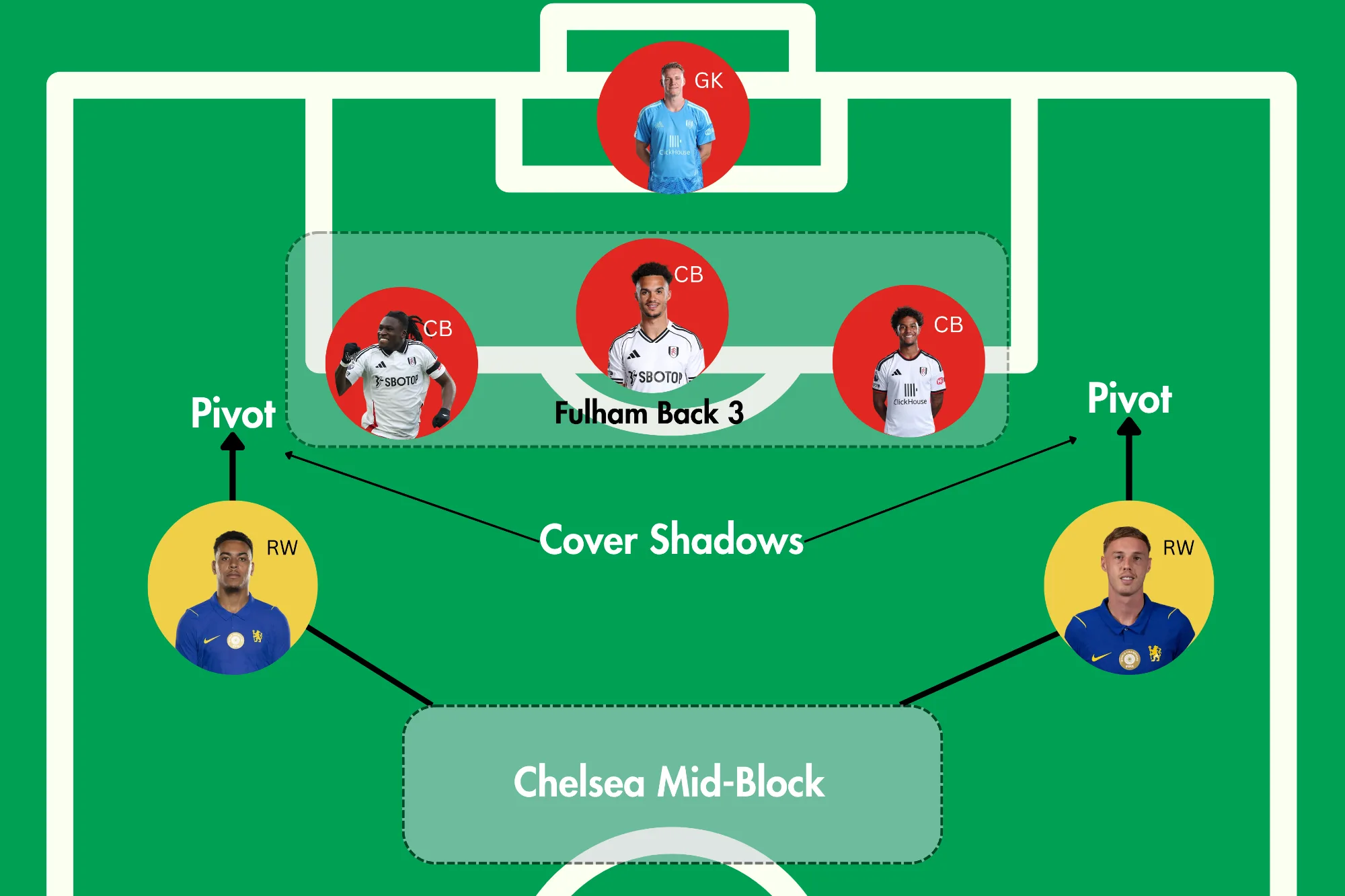
The Pressing Trigger: When Fulham moved the ball out wide, the nearest #10 stepped up to press the wide center-back while keeping the central pivot tucked securely inside their cover shadow.
Midfield Backing: The moment a #10 stepped up, Romeo Lavia and Reece James immediately pushed high out of midfield to seal off the remaining central options.
This exact trap forced a high-turnover opening goal less than 60 seconds into the match.
2. Tactical Flexibility: The 5-2-3 Mid-Block
Chelsea didn’t attempt to press high for 90 minutes. After Fulham equalized, Chelsea seamlessly adapted into a compact 5-2-3 mid-block designed to control the middle third and force Fulham into wider, less dangerous zones.
Protecting the center often leaves wide regions exposed especially against aggressive fullbacks. Alonso solved this without sacrificing his defensive line:
Patient Wing-Backs: Rather than stepping up early and risking a five-vs-four overload against Fulham’s front line, Chelsea’s wing-backs stayed deep to maintain man-to-man coverage.
Narrow Dual #10s: Palmer and Rogers narrowed their positions to clog central channels. Once Fulham passed wide, the duo sprinted out to support the flanks, effectively closing down spaces without pulling Chelsea's center-backs out of position.
3. Transition Threats & Second-Half Deficiencies
Chelsea’s out-of-possession defensive shape directly unlocked their counter-attacking speed. By holding narrow positions during Fulham’s build-up, Palmer and Rogers were primed to sprint into the vacant space behind Fulham’s committed fullbacks immediately upon a turnover.
Backline Coordination Concerns
While the attacking transitions looked lethal, Chelsea’s defensive coordination revealed clear early-season rust:
Manipulated Space: Fulham’s deep runners frequently pulled Chelsea’s center-backs into uncomfortable positions where they were reluctant to follow.
Gaps Between the Lines: When the center-backs retreated to defend direct long balls, the space between Chelsea’s pivot and their defensive line expanded, giving Fulham's attacking midfielders room to turn and drive forward.
4. In-Possession Fluidity: Overloading the Half-Spaces
While Chelsea spent most of the night out of possession, their attacking shape showed notable fluid dynamics when on the ball:
Asymmetric Half-Space Overloads: Rather than sticking strictly to their respective left and right half-spaces, Palmer and Rogers often overloaded the same side of the pitch to outnumber Fulham’s central midfielders.
Underlapping Center-Backs: Wide center-back Josh Acheampong repeatedly pushed forward from the backline, combining with Palmer and Malo Gusto to create 3-v-2 overloads down the right wing.
Final Verdict: Can Palmer and Rogers Sustain the Workrate?
Alonso’s Premier League opening victory proved that tactical triggers beat reckless running. By turning dual playmaker roles into primary defensive components, Chelsea controlled the match despite surrendering majority possession.
However, the defining question for Chelsea’s season isn't whether Alonso’s system works it’s whether Palmer and Rogers can physically sustain these taxing defensive demands over a grueling 38-game campaign.